1. Прочитать текст

2. Выполнить задания к тексту



1. Раскройте скобки, употребив глагол в Present Simple, Past Simple или Future Simple.
2. Поставьте глагол to be в одну из форм Simple.
3. Выпишите из текста глаголы в форме Present Simple, Past Simple и Future Simple. Переведите текст.
Clara had a car accident when she was ten years old. When she grew up she was afraid of cars. Then she met Brad who was a professional racing driver. He wanted to help her and drove her in his car every day. So in five years Clara became a racing driver too. Now she drives 200 km per hour and takes part in sports championships. She really enjoys driving and has a lot of future plans. Next year she will open a driving school. And Clara and Brad will get married quite soon.
4. Превратите утвердительные предложения в отрицательные, обращая внимание на форму глагола-сказуемого.
Две английские формы времени Past Simple (прошедшее простое) и Past Continuous (прошедшее длительное) обозначают события, которые произошли в прошлом и не имеют никакой связи с настоящим. Главное отличие Past Simple от Past Continuous заключается в том, что в первом случае нам важно показать последовательность событий в прошлом, а во втором - подчеркнуть длительность действия в конкретный момент времени в прошлом.
Past Simple используется для последовательности событий в прошлом, когда нам важно показать, какое событие произошло первым. Past Continuous выражает процесс в определенный момент в прошлом.
Например:
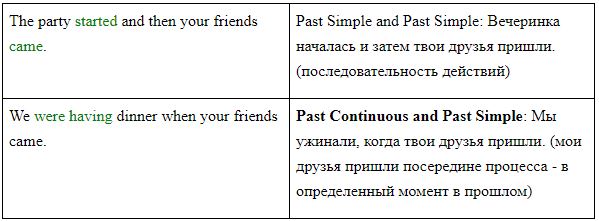
1. Мы часто используем Past Continuous и Past Simple вместе. Когда это происходит, Continuous описывает более длительное действие или ситуацию, на фоне которой происходит однократное событие.
e.g. When I woke up this morning it was raining .
I was walking home, when I saw my old friend buying a newspaper.
I broke my leg when I was skiing .
I was playing a computer game when my phone rang .
В данных примерах Past Continuous описывает ситуации, которые продолжаются в течение некоторого времени - «was skiing» и «was playing», в то время как Past Simple описывает действия, которые происходят быстро - «broke» и «rang».
2. Мы используем Past Continuous, когда говорим о том, что происходило в определенное время или в период времени в прошлом. В отличие от Past Continuous Past Simple употребляется для выражения однократного действия в прошлом.
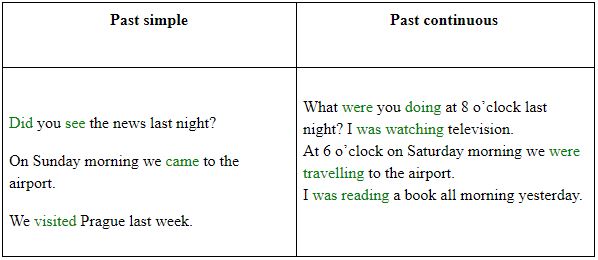

Упражнение 1. Раскройте скобки, употребляя глаголы в Past Simple или Past Continuous.
Упражнение 2. Заполните пропуски в диалоге, используя глаголы в Past Simple или Past Continuous.
Ann: How ____ your holiday at the seaside?
Ben: Oh, it ____ wonderful, thank you! We ____ a great fun!
Ann: What (you / do)______________there?
Ben: In the mornings, while my parents still (have breakfast) _______, I (play) _____ tennis with my friend Harry. After that, at about 10 o’clock we (swim) _____ in the sea and (play)______ football on the beach.
Ann: Yes, that sounds good! And what (you / do)______ in the afternoons after your lunch?
Ben: After lunch (we / go)______ on some interesting excursions around the place where (we / stay) _______ that week. In the evenings after dinner (we /watch)_______ films on TV or (we / play) ______ chess with my Dad.
Ann: I see, and what (you / do)_______ between 5 pm and dinner time?
Ben: Well, when the weather was nice and warm, my friend and I (have fun)_______ at the seaside. We (swim)________or (play)_________volleyball on the beach.
Ann: Fantastic! Next time I’ll go with you.
Упражнение 3. Переведите предложения на английский язык, используя глаголы в Past Simple или Past Continuous.
Упражнение 4. Заполните пропуски в диалоге, используя глаголы в Past Simple или Past Continuous.
Упражнение 5. Заполните пропуски, используя while или when.
Союз while подчеркивает длительность и глагол после него ставится в Continuous, в то время как when подчеркивает факт, и глагол после него ставится в Simple.
СРАВНИТЕ:
1. I was waiting for the school bus … I saw Nathan.
2. My mum preparing dinner … telephone rang.
3. Paul and Mary finished their work … Granny was making tea.
4. The vase fell from the shelf, … I was watching TV.
5. I was driving along … a dog ran onto the road.
6. My sister was washing her hair … she was listening to the music.
* * *
Упражнение 6. Заполните пропуски глаголами в Past Continuous или Past Simple и переведите предложения.
Упражнение 7 А. Раскройте скобки и поставьте глаголы в нужной форме.
I ____ (meet) a man in a pub once and he _____ (tell) me this story. A friend of his______ (work) on his car one morning. This friend ______(have) a large dog. Before he _______ (start) work, he ________ (put) the dog in the car and _________ (close) the door. Well, he was under his car, ________ (work) busily, when suddenly he _________ (hear) a mechanical noise, and the car ________ (start) to move forward. He ________ (jump) up, but too late — the car ___________ (roll) slowly down the hill, and the dog __________ (sit) at the wheel as if it _________ (drive). Finally, it ________ (come) to rest in a neighbour’s garden.
Упражнение 7 Б. Раскройте скобки и поставьте глаголы в нужной форме.
When I ____ (go) shopping, I _____ (see) my friend. I ___ (say) ‘Hello!’ and we____ (start) talking. While we _____ (talk), a car _____ (run into) a man on a bike. When we _______ (see) the accident, I ______ (phone) for an ambulance. While I _______ (wait) for the ambulance, a policeman _______ (arrive). He (ask) us some questions. The ambulance _______ (come), while I ________ (talk) to the policeman. The ambulance _______ (take) the man to hospital and we _______ (go) to a cafe for a cup of coffee. While we ______ (drink) our coffee, we _______ (discuss) about the accident.
Present Continuous Tense (или Present Progressive Tense) переводится с английского языка как «настоящее длительное время». В английской речи оно употребляется наравне с Present Simple, с той же частотой, и занимает важное место в грамматике.
Когда используется Present Continuous — когда требуется подчеркнуть длительность действия в настоящем. Пределы «длительности» могут быть разными: действие может продолжаться неопределенный срок или занимать определенный промежуток времени ¬ все это случаи употребления Present Continuous.
Согласно правилам английского языка, любое предложение строится в определенном порядке. В утвердительных предложениях подлежащее занимает первое место, сказуемое — второе. В Present Continuous сказуемое составляют вспомогательный глагол to be и основной (смысловой) глагол, который выражает действие. To be принимает нужную форму (am, is, are) в зависимости от подлежащего, а основной глагол приобретает окончание -ing.
Формула: I am + глагол-ing: I am singing - Я пою (сейчас).
Формула: He/She/It is + глагол-ing:
He is smiling - Он улыбается.
She is dancing - Она танцует.
It (the Sun) is shining - Оно (солнце) светит.
Формула: We/You/They are + глагол-ing:
We are listening - Мы слушаем.
You are reading - Вы читаете.
They are swimming - Они плавают.
Когда Present Continuous употребляется в отрицательных предложениях, вспомогательный и основной глагол разделяются частицей not.
В случаях употребления Present Continuous в вопросительных предложениях вспомогательный глагол занимает первое место, за ним следует подлежащее и далее основной глагол.
1. Действие происходит прямо сейчас, в момент речи. Также можно употреблять конструкцию Present Continuous для нескольких происходящих одновременно в настоящем действий. Слова-маркеры: now (сейчас), at the moment (в данный момент).
Пример: She is eating apple while I am drinking juice - Она ест яблоко, пока я пью сок. (два действия совершаются одновременно)
2. Действие растянуто во времени и происходит в настоящем, но не ограничивается настоящей секундой. Оно началось какое-то время назад и будет продолжаться еще некоторое время. В течение этого отрезка времени выполняется обозначенное действие.
Слова-маркеры: now (сейчас), currently (сейчас, теперь), these days (В эти дни, на днях).
Пример: We are moving into a new house - Мы переезжаем в новый дом. (Мы заняты процессом переезда и продолжим его, но в момент речи мы не заняты конкретно этим, просто находимся в состоянии переезда)
3. Ситуация имеет временный характер.
4. Действие развивается или постоянно меняется, предложение часто содержит определенные глаголы для его обозначения. Описание процесса изменения - это случай употребления Present Continuous.
Слова-маркеры:
get (становиться) become (становиться)
change (меняться) start (начинаться)
rise (подниматься) improve (улучшаться)
fall (падать) begin (начинаться) grow (расти)
Пример: Your English is getting better - Твой английский становится лучше. (наблюдается постепенное повышение твоего уровня английского)
1. Дело запланировано и обязательно будет совершено в ближайшем будущем, часто с указанием сроков, места или каких-либо других деталей.
Слова-маркеры: this/next week (на этой/следующей неделе), tonight (вечером), today (сегодня), tomorrow (завтра), this/next year (в этом/следующем году), this/next weekend (в эти/следующие выходные).
Пример: Next week we are buying a new car - На следующей неделе мы покупаем новую машину. (мы не просто решили, а уже выбрали марку машину и автосалон, где будет совершена покупка)
2. Речь идет о действии в настоящем, влияющем на ближайшее будущее с употреблением глаголов, обозначающих движение.
Слова-маркеры: go (идти), move (двигаться), leave (уходить), start (начинать), come (приходить), return (возвращаться).
Пример: I’m tired. I am going to bed. - Я устал. Я иду спать. (прямо сейчас я чувствую усталость и пойду спать сразу после того, как сообщу об этом)
3. Речь эмоционально окрашена, говорящий испытывает недовольство, раздражен или возмущен чем-то, что постоянно случается.
Слова-маркеры: all the time (все время), always (всегда), constantly (постоянно)
Пример: You are always interrupting me! - Ты постоянно меня перебиваешь! (ты делаешь это все время, и меня это раздражает)
4. Present Continuous - случаи употребления с глаголами состояния.
Такие глаголы в английском языке по правилам не употребляются в настоящем времени, поскольку обозначают чувства, умственные процессы, которые не имеют временных пределов — эти глаголы выражают скорее состояние, чем действие.
Однако если необходимое вам значение такого глагола — конкретное действие, имеющее начало и конец, то фраза может строиться по формуле Present Continuous.
Слова-маркеры: to love (любить), to feel (чувствовать), to wish (желать), to think (думать), to see (видеть), to look (выглядеть), to smell (пахнуть), to have (иметь) и другие
1. Речь идет о чем-то новом с противопоставлением старому.
Пример: He has left university, now he is working with his friend - Он бросил университет и теперь работает со своим другом.
2. Речь идет о необычном поведении определенного человека, он внезапно начал вести себя не так, как раньше.
Пример: She is eating too much - Она слишком много ест. (до этого у нее не было такого хорошего аппетита)
3. Present Continuous используется в придаточных предложениях времени после союзов. В предложении говорится о двух действиях, одно из которых единичное или «короткое» (Present Simple), второе длительное (Present Continuous). Для действия, которое происходит “на фоне”, используют Present Continuous, а для прерывающего его события — Present Simple.
Слова-маркеры: as long as (пока), when (когда), in case (в случае если), if (если), while (в то время как), unless (пока не).
Пример: I try not to make noise in case my daughter is reading her book - Я стараюсь не шуметь, когда моя дочь читает.
Упражнения на закрепление
Упражнение 1. Read what a boy is saying. Write in am, is or are.
I'm in the park. I can see some children. They ____ playing volleyball. There's my friend Greg! He ____ reading a book. The girl ____ eating a sandwich. The boy and the dog ____ playing with a ball. They can't see me because I ____ sitting in a tree. What ___ you doing? ____ you listening to me?
B)
Упражнение 2. Write the words in the ing-form form.
Feed, walk, wash, play, do
Упражнение 3. Make up negative sentences in Present Progressive.
Упражнение 4. Make up questions.

